
Qrypto Con
The Applied Cryptography Conference

Crack the future before it cracks you! Quantum, AI, and 47-day certs are rewriting the rules of encryption… fast. Spend two days with the people already building what’s next.
Something went wrong. Please try again.

Agenda December 9th 2026

8:00am CT
Qrypto Con
Keynote Session
Learn more
Encryption Consulting has been moving fast, and in this keynote Puneet Singh, Principal at Encryption Consulting, shares the strides the company has made across its product portfolio. He takes you through the latest advancements in certificate lifecycle management, cryptographic discovery and PKI as a service, and shows how these solutions help enterprises stay ahead of post-quantum readiness and shorter certificate lifetimes.
Puneet will also unveil Encryption Consulting’s new agentic AI security solution, which brings PKI-based identity and trust to AI agents. Attendees leave with a clear view of what is available today and what is coming next.

Puneet Singh
Principal
Encryption Consulting
9:00am CT
PQC Isn’t the First Cryptographic Transition, and It Won’t Be the Last
Learn more
The transition to Post-Quantum Cryptography (PQC) has brought renewed attention to the concept of cryptographic agility, or the ability to transition between cryptographic algorithms as requirements and standards evolve. But while this term may feel new to many organizations, the challenge itself is not.
In this session, we’ll explore the origins and evolution of cryptographic agility, examine lessons from previous cryptographic transitions, and consider how those lessons can help organizations prepare for the move to PQC.
We’ll also look beyond the immediate post-quantum transition to what true, long-term cryptographic agility means for building security architectures that can adapt to whatever comes next.

Adam Cason
VP of Global and Strategic Alliances
FutureX
10:00am CT
Automate or Outage: Mastering PKI and Certificate Lifecycle Management from Issuance to Renewal
Learn more
Digital trust depends on certificates, yet expired and mismanaged certificates continue to be one of the most common causes of avoidable outages. From disrupted customer-facing applications and failed transactions to downtime affecting critical infrastructure, organizations are learning the hard way that certificate lifecycle management is no longer a back-office operational task. It is a business resilience imperative. This session explores the evolving challenges of managing certificates across hybrid, cloud, and increasingly automated environments. We will examine the certificate lifecycle from issuance and deployment through renewal, revocation, and retirement, highlighting where organizations commonly lose visibility and control.

Nandita Das
Sr Manager, Cybersecurity
EY
11:00am CT
Beyond the Algorithm:
Engineering Trust Through Crypto-Agility
Learn more
Cryptographic trust is not a permanent property of an algorithm. It is a system-level assurance that rests on mathematical assumptions, implementations, keys, identities, protocols and operational controls. When any of them changes, trust has to be re-established, not assumed.
This session starts with a decision many organizations face this year: a post-quantum proof of concept has passed. The algorithms are standardized and the provider supports them. Would you approve production deployment?
To answer, we separate two pressures that are often blurred together. Quantum computing threatens the hardness assumptions behind RSA and elliptic-curve cryptography, and harvest-now-decrypt-later creates a present-day collection risk for data requiring long-term confidentiality. AI stresses identity, provenance and delegated authority without breaking the algorithms themselves. The distinction matters: PQC addresses changing hardness assumptions, but it does not, by itself, establish identity, provenance or authorization.
We then follow two concrete migration scenarios end to end. In the first, ML-DSA and SLH-DSA keep the familiar Sign/Verify interface but change the sizes systems were built around. In a hypothetical application, a 3,309-byteML-DSA-65 signature fits within a 4,096-byte limit, but its 4,412-character Base64 representation exceeds a 4,096-character text field. In the second, ML-KEM encapsulation changes the programming model behind ECDH style abstractions, and hybrid X25519MLKEM768 in TLS 1.3 (RFCs 9954 and 10024) shows how a protocol can absorb that change without itself providing post-quantum peer authentication.
The talk closes with two practical tools for deciding what must change and what evidence establishes readiness: four dimensions of crypto-agility (algorithm, primitive, protocol and operational) and Cipher Citadel’s five question method. We then return to the opening proof of concept and reach a scoped decision the evidence actually supports, treating crypto-agility as a critical capability for managing cryptographic change, not a universal answer to digital trust.
Key Takeaways:
– Algorithm support is a feature; crypto-agility is a system capability. A passing PQC proof of concept proves the mechanism works, not that the required security properties survive across applications, protocols and operations.
– 7Stable primitives can still break system contracts. Signature sizes, encodings and KEM semantics can silently violate field limits, formats and abstractions.
– Trust requires evidence. Interoperability, telemetry and rollback evidence support a scoped deployment decision that states plainly what is and isn’t protected.

Siddharth Chaini
Principal Technical Lead
Thales
2:00pm CT
Stop Hiring PQC Experts. Fix Your PKI First.
Learn more
The cybersecurity industry is racing towards post-quantum cryptography. Vendors are promoting quantum-safe solutions, organisations are building migration roadmaps, and everyone seems to be looking for PQC expertise.
But here’s an uncomfortable question: How can you prepare your cryptographic infrastructure for tomorrow when you don’t fully understand or control what you have today?
The biggest challenge in PQC migration isn’t necessarily the algorithms. It’s the underlying PKI infrastructure, fragmented certificate ownership, incomplete cryptographic inventories, manual processes, legacy dependencies, and lack of operational maturity.
Having spent over 15 years working across enterprise PKI, encryption and cybersecurity, I’ve seen firsthand how these foundational challenges can undermine even the most ambitious security transformation programmes.
This session challenges the industry narrative that quantum readiness starts with adopting new algorithms. Instead, we’ll explore why organisations must first establish visibility, strengthen certificate lifecycle management, modernise their PKI architecture, and build genuine crypto-agility.

Kiruthiga (Kiru) Chandrasekaran
Vice President
Jefferies
3:00pm CT
Building a Trust Architecture for Agentic AI Using PKI
Learn more
As there is an increasing trend in the adoption of AI agents and their usage of sensitive systems it is essential to prove who AI agents are and how to trust AI agents. Public Key Infrastructure or PKI can give a trust layer by using cryptographic identities, authentication, digital signatures and certificates for validation. In this discussion I look at how PKI can be used in AI environments to set up AI agent identity keep AI agent-to-AI agent conversations safe set clear access limits and keep track of actions for accountability. I also examine challenges such, as changing AI agent lifecycles giving authority to others managing certificates and revoking trust.

Rupesh Paterical
Manager Advisory Services
PWC
Agenda December 10th 2026
8:00am CT
Identity After RSA: Building a Crypto-Agile, Quantum-Safe Trust Fabric for Humans, Machines and AI Agents
Learn more
Enterprise identity is rapidly expanding beyond users and devices to workloads, applications and autonomous AI agents. At the same time, advances in quantum computing are forcing organizations to reconsider the cryptographic foundations that protect authentication, certificates, digital signatures and trusted communications. This session explores how organizations can prepare Microsoft identity and PKI environments for this next generation of digital trust. We will look beyond simply replacing RSA or ECC with post-quantum algorithms and focus on cryptographic agility—the ability to discover, manage and transition cryptographic dependencies without disrupting critical services.

Zoheb Shaikh
Cloud Solution Architect
Microsoft
9:00am CT
Key Management as Code with
Azure Managed HSM
Learn more
Azure Managed HSM gives you hardware-backed key protection in the cloud. In many organisations, though, the keys inside it are still managed by hand. They get created in the portal, permissions are granted ad hoc, rotation lives in someone’s calendar, and nobody can say with confidence who can use which key.
This session shows how to run Managed HSM entirely as code, from an empty subscription to keys in use. We create and activate the HSM through a pipeline, with the security domain protected by keys that never leave a physical HSM. From there, Terraform manages least-privilege custom roles scoped to individual keys, key creation, rotation policies and key deletion. Every change goes through a pull request, and a policy check on the Terraform plan blocks weak keys before they reach production.
The live demo uses an open, reusable repository, and includes a confidential VM scenario with secure key release. Along the way you’ll hear the practical gotchas: soft-delete and purge protection, control-plane versus data-plane permissions, and why some steps deliberately stay out of Terraform.

Vito Minheere
PKI & Cryptographic Infrastructure Automation
ASML
10:00am CT
The Rise of Machines:
When AI Meets Quantum
Learn more
Artificial intelligence and quantum computing are advancing along separate paths, but their convergence could fundamentally reshape cybersecurity. AI agents are evolving from tools that provide information into autonomous actors that can access data, invoke APIs, execute transactions, and interact with other machines. This creates an immediate question of trust: How do we prove that an AI agent is who it claims to be, determine who authorized it, and control what it is permitted to do?
At the same time, AI is accelerating vulnerability discovery and exploitation, compressing the time defenders have to identify and remediate weaknesses. Internal threat-landscape material already highlights the growing gap between time-to-exploit and time-to-remediate.
Quantum computing introduces the longer-term risk of undermining cryptographic foundations protecting identities, communications, and data. Together, these technologies create a race between machine-speed attack, quantum-enabled computing, and the evolution of cryptographic defenses.
This presentation explores that convergence and the architectural choices organizations must make today to preserve identity, resilience, and digital trust.
Key Takeaways:
1. The identity crisis – Strategy to deal with agents differently than humans esp. in verifying identity and at scale
2. Attack at machine speed – What changes in the vulnerability management ecosystem to account for the speed of quantum and the force of AI
3. Cryptographic transition problem – How can organizations plan to protect their cryptographic architectures
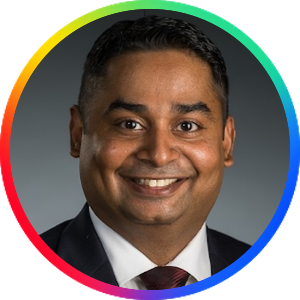
Ram Sankaran
Director, IT Security
Prime Therapeutics
11:00am CT
CBOM remediation – Architecting for Crypto-Agile Data Protection
Learn more
Crypto-agility depends on abstracting security functionality from individual applications. A centralized cryptographic engine establishes and maintains the policy, while enforcement is done across distributed endpoints. The architecture makes a CBOM actionable. It maps what the inventory finds to the data it protects, so the centralized policy can be enforced to remediate weak or deprecated cryptography. The approach delivers not only post-quantum readiness but also the ability to instantly adapt to evolving operational and regulatory requirement, without rearchitecting applications.
Key Takeaways:
- CBOM delivers the map, the crypto-agile architecture provides the implementation framework
- Separating policy from enforcement is the structural change that makes crypto-agility possible
- Centralized policy defines what algorithms and keys are allowed – distributed endpoints enforce how the policy propagates to applications across the deployment environment
- Same architecture that prepares organizations for post-quantum also lets them respond instantly to future operational and regulatory changes, without an application overhaul

Juan C. Asenjo
Director of Product Management
Prime Factors
Speakers
Puneet Singh
Principal
Encryption Consulting
Zoheb Shaikh
Cloud Solution Architect
Microsoft
Adam Cason
VP of Global and Strategic Alliances
FutureX
Nandita Das
Sr Manager, Cybersecurity
EY
Siddharth Chaini
Principal Technical Lead
Thales
Kiruthiga (Kiru) Chandrasekaran
Vice President
Jefferies
Rupesh Paterical
Manager Advisory Services
PWC
Ram Sankaran
Director, IT Security
Prime Therapeutics
Vito Minheere
PKI & Cryptographic Infrastructure Automation
ASML
Juan C. Asenjo
Director of Product Management
Prime Factors